
Consulting — Lean · Six Sigma · Reliability
Lean. Six Sigma. Reliability. The methodology the problem demands.
Most improvement engagements are led by a process specialist or a reliability engineer — rarely both. This practice holds all three disciplines: Lean for flow and waste, Six Sigma for variation and defects, reliability engineering for asset failures. The approach is determined by what the problem actually requires.
CSSBB
Lean Six Sigma MBB
ASQ CRE
~$20M delivered across industrial manufacturing · 30 years across discrete (automotive, defense) and process industries (chemical, packaging, paper) ·
How the Approach Is Chosen
The methodology follows the problem.
No single framework solves every problem. The starting point is always the same question: what kind of problem is this? The answer determines which tools get used.
Lean — VSM & Kaizen
Waste, flow, lead time, throughput
Slow processes, excessive WIP, long changeovers, layout inefficiencies, under-utilized capacity, operational waste.
DMAIC — Six Sigma
Variation, defects, warranty, quality
Chronic defect problems, process capability gaps, customer returns, warranty costs, measurable quality targets.
RCA — Asset Reliability
Asset failures, recurrence, maintenance
Chronic defect problems, process capability gaps, customer returns, warranty costs, measurable quality targets.
Lean Practice
Value Stream Mapping, Kaizen, and the Full Lean Toolkit
Lean is not a training course — it is hands-on delivery. VSM workshops at steel and packaging manufacturers. Kaizen events across HVACR, chemical, and industrial operations. TPM and autonomous maintenance programs across 60+ global manufacturing sites. The tools are applied where the problem is, not where they are comfortable.
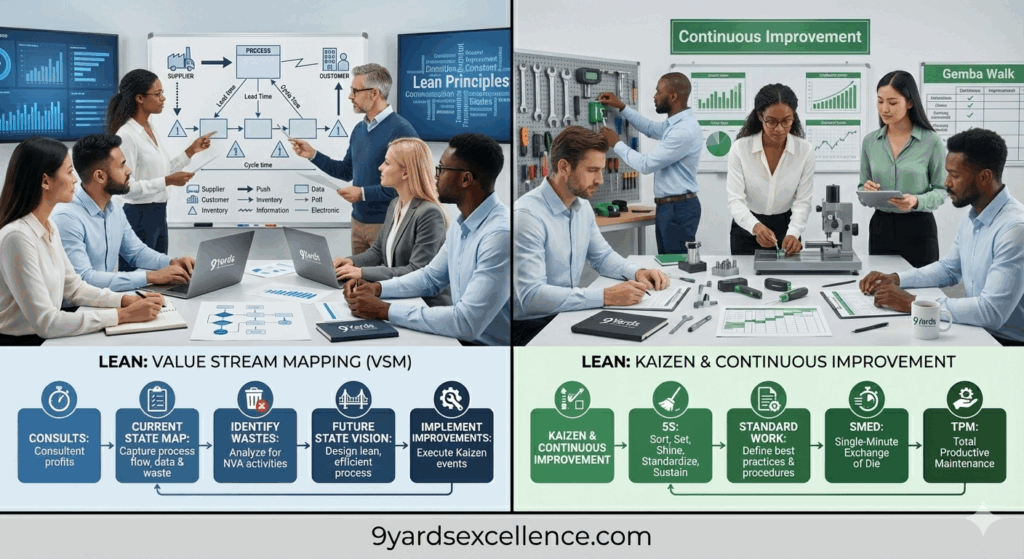
Value Stream Mapping (VSM)
End-to-end current state mapping — cycle time, WIP, changeover, yield, lead time at every step. Future state design with targeted kaizen bursts. Applied across production, logistics, and service processes including steel slab movement, marine cargo logistics, warehouse design, and QA laboratory workflows.
Kaizen Events
Structured rapid improvement events (PDCA-based) with cross-functional teams. Scope is bounded and targeted — waste elimination, flow improvement, standard work, or layout redesign. Multiple events led across chemical, HVACR, and steel manufacturing — ~$20M cumulative hard and soft savings delivered.
TPM & Autonomous Maintenance
Total Productive Maintenance implementation — shifting equipment ownership to operators, building autonomous maintenance routines, and improving OEE. Implemented as a global program across 60+ manufacturing sites in multiple regions. 10–30% uptime improvement delivered.
Standard Work & Daily Management
Variance reduction through current standards validation and structured daily management systems (SQDC — Safety, Quality, Delivery, Cost). Hoshin-Kanri strategy deployment and A3 problem solving for sustained organizational performance. Applied across HVACR, chemical, and industrial manufacturing operations.
More tools in toolkit:
SMED/Quick Changeover
5S/6S
Cellular Manufacturing
A3-Problem Solving
KANBAN
Hoshin Kanri
Daily Management (SQDC)
Visual Management KPIs
OEE Improvement
Six Sigma
DMAIC — Structured Improvement
Applied to chronic performance problems, recurring defects, quality escapes, and process variation in existing operations. The methodology is unchanged. The application is specific to your problem, your data, and your operating environment.
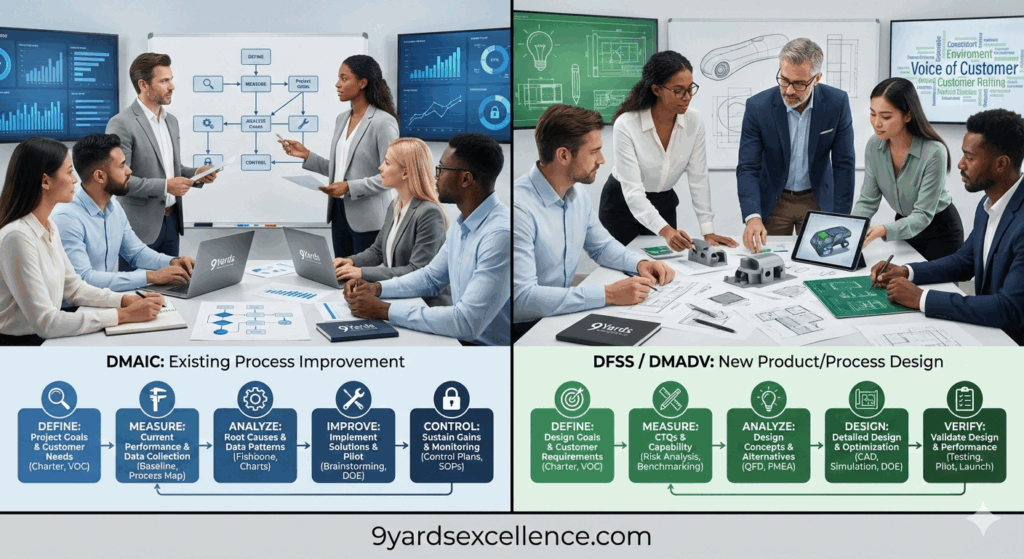
D
DEFINE
Problem statement, scope, VOC, project charter, business case
M
MEASURE
Baseline capability, MSA / Gage R&R, data collection plan, process map
A
ANALYZE
Root cause identification, statistical analysis, evidence-grounded findings
I
IMPROVE
C
CONTROL
Control plans, monitoring systems, process handoff and sustainment
The Analyze phase is where most DMAIC projects stall or produce incorrect conclusions. AI-assisted root cause analysis can compress weeks of manual investigation into a structured, evidence-grounded output — without changing the decision-making responsibility of the engineering team.
engagements
What We Deliver
Every engagement is scoped to the specific problem — not a standard package applied uniformly. Scope, duration, and deliverables are defined at the start.
Lean Transformation — VSM & Kaizen
Current state Value Stream Mapping, future state design, and Kaizen event facilitation targeting waste, lead time, flow, and throughput. Scoped from a single production line to a full plant-level transformation.
Six Sigma Project Leadership
End-to-end delivery of a DMAIC improvement project — from problem definition through control plan handoff. Includes coaching the internal team throughout so the capability stays when the engagement ends.
Statistical Data Analysis
Minitab, SAS-JMP, R — regression, hypothesis testing, DOE, MSA, Gauge R&R, SPC. Weibull analysis and failure rate modeling for reliability. Monte Carlo simulation. PCA for downtime and defect analysis.
Master Black Belt Project Coaching
GB and BB candidate mentoring — project selection, tollgate review, statistical methodology, and delivery accountability. Builds internal capability that outlasts the engagement. Delivered across global manufacturing organizations in multiple industries.
Operational Excellence Programs
Global OE program design — KPI frameworks, Power BI dashboards, TPM rollout, SAP PM optimization, maintenance best practice standardization. Built and led across 60+ manufacturing sites in multiple regions worldwide.
DFSS / DCOV Project Support
Design for Six Sigma for new product or process development — DCOV, DMADV, IDOV. Designed-in performance and reliability using DOE, tolerance analysis, parameter design, and analytical robustness methods.
Where the Platform fits
AI-accelerated investigation within your DMAIC workflow
The platform is not required for every engagement. It is available where the investigation scope, evidence volume, or time pressure makes it the right tool for the Analyze phase.

The Analyze phase is where investigations stall
Root cause identification in complex failure events requires synthesising maintenance records, sensor data, inspection reports, operator statements, and supplier documentation — simultaneously, without confirmation bias. Done manually, that synthesis takes weeks. Done poorly, it produces a corrective action that addresses the symptom, not the cause.
The 9 Yards RCA AI Engine runs that synthesis in a single session — across 13 structured analytical frameworks, with every finding grounded against the actual evidence documents, scored for confidence, and flagged where the evidence is insufficient. The engineering team reviews, challenges, and decides. The AI handles the synthesis.
The result is an investigation-ready structured report the DMAIC project team can act on directly — with a full evidence trail that satisfies both the engineering review and the audit requirement.
- Root cause investigations accelerated from weeks to hours
- Citations grounded against actual evidence documents
- Per-module confidence scoring — the analysis knows what it doesn't know
- Contradictions detected, flagged, and resolved
- Audit-ready structured PDF, consistent format
- Connects directly to G8D corrective action workflow
How Engagements Work
The 5-D engagement — from definition to delivery
No retainer, no open-ended statement of work. Every engagement follows the same structured arc — scoped to your specific problem, the methodology determined by what the problem actually requires. We work across quality, manufacturing, engineering, and maintenance — and we stay through implementation, not just the analysis.

D1 – DEFINE
Configure the work order — asset, failure mode, business context. Upload every evidence document: maintenance records, DCS exports, inspection reports, witness statements.

D2 – DIAGNOSE
The AI runs 14 analytical modules simultaneously — 5-Why, FMEA, FTA, Causal Model, Knowledge Graph, RBD and more. Every finding evidence-cited and confidence-scored.

D3 – DESIGN
Review the structured output. The introspection layer surfaces blind spots and assumptions. Annotate, challenge findings, and trigger targeted re-analysis with your feedback.

D4 – DEPLOY

D5 – DELIVER
Export the audit-ready PDF — IATF and customer-ready format. Every finding traceable to its source evidence document. Closed report feeds the KB for future incident detection.
Have a problem that keeps coming back?
Describe what you’re dealing with — a recurring defect, a quality event, a process that isn’t performing, or a new product development challenge — and we’ll tell you directly whether a structured engagement can help and how.