
Case Study – Automotive Manufacturing
From Brake Shudder to Root Cause in Hours, Not Weeks
How AI-assisted Root Cause Analysis identified a systemic change management failure behind a brake component field escalation — grounded in 109 evidence citations across 13 analytical modules.
The Situation
Brake Shudder. Two Plants.
One Cause Nobody Saw.
A Tier 1 brake component supplier faced a field failure escalation involving Disc Thickness Variation (DTV) on front brake rotors, manifesting as brake shudder in customer vehicles. The failure was occurring at two manufacturing plants — but at dramatically different rates.
The initial assumption was a production defect. The evidence pointed elsewhere. A material change made months earlier — classified as routine — had bypassed every quality gate designed to catch exactly this kind of failure.
Connecting those dots required analyzing 20 evidence documents across procurement records, sensor logs, inspection reports, validation protocols, and operator statements — simultaneously, with no confirmation bias.
What Made This Hard
- Two plants, one part, divergent failure rates. Plant A (Southeast U.S) failed at 3× the rate of Plant B (Northern Mexico) — same part, same process specification, different environment.
- Change records were incomplete and misfiled. The coating change was documented as an “equivalent substitution,” which meant no engineering review trail to follow.
- Evidence actively contradicted itself. DCS sensor readings and operator logs disagreed on two critical parameters. Resolving those contradictions correctly changed the root cause.
- The failure mechanism was geometry-dependent. Validation testing used flat coupons. The actual failure happened at ventilation slot edges — a geometry never tested.
The Investigation
What the AI Engine Analyzed
The 9 Yards RCA AI engine processed 20 evidence documents and ran the investigation across 13 structured analytical modules — simultaneously, with every claim grounded against actual evidence items.
20
Evidence Documents
109
Grounded Citations
13
Analytical Modules
3
Contradictions Detected
2%
Hallucination Risk
98%
Overall Confidence
Contradictions Detected and Resolved
- DCS environmental sensor readings at Plant A conflicted with operator log entries on coating booth conditions — DCS data treated as authoritative.
- DCS process monitoring records on coating application parameters conflicted with operator-recorded values — DCS data treated as authoritative.
- Physical metallurgical evidence (SEM analysis at ventilation slot edges) conflicted with the supplier’s validation test result, which passed on flat coupon geometry — physical failure evidence treated as authoritative.
The FINDINGS
What Was Found
ROOT CAUSE
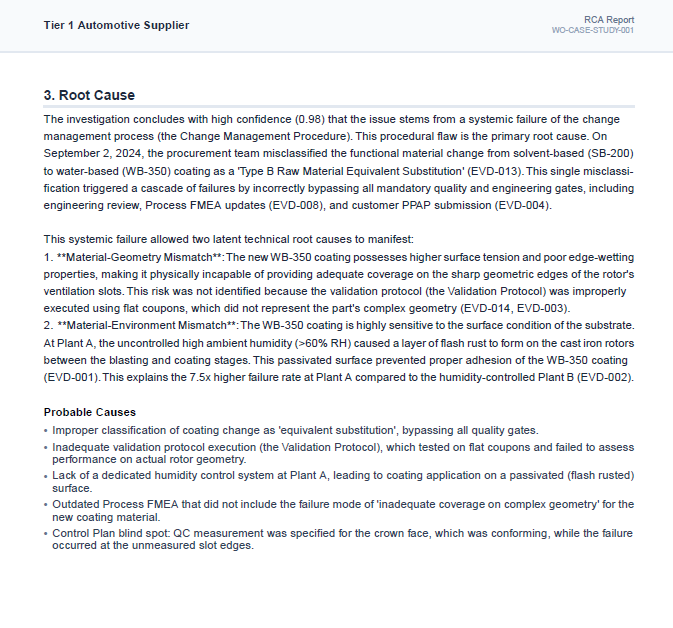
Systemic failure of the change management process. The switch from solvent-based coating SB-200 to water-based coating WB-350 was improperly classified as a “Type B Equivalent Substitution” by procurement — a classification that bypassed mandatory engineering review, geometry-specific validation, FMEA and Control Plan updates, and customer PPAP submission.
This systemic failure allowed two latent technical causes to manifest: the new coating’s poor edge-wetting properties on complex rotor geometry, amplified at Plant A by high ambient humidity causing flash rust on the substrate before coating application.
Probable Cause 1
Coating change classified as “equivalent substitution” — bypassing all quality gates including engineering review, PPAP, and geometry-specific validation.
Probable Cause 2
Validation protocol tested on flat coupons only. The failure mode — inadequate edge coverage on ventilation slot geometry — was never assessed.
Probable Cause 3
No humidity control at Plant A. WB-350 applied to flash-rusted surface, causing poor adhesion — explaining the 3× higher failure rate vs. Plant B.
THE OUTPUT
What the Report Delivers
The RCA AI engine produces a structured, audit-ready PDF with grounded citations, per-module confidence scoring, and full traceability from finding to evidence.
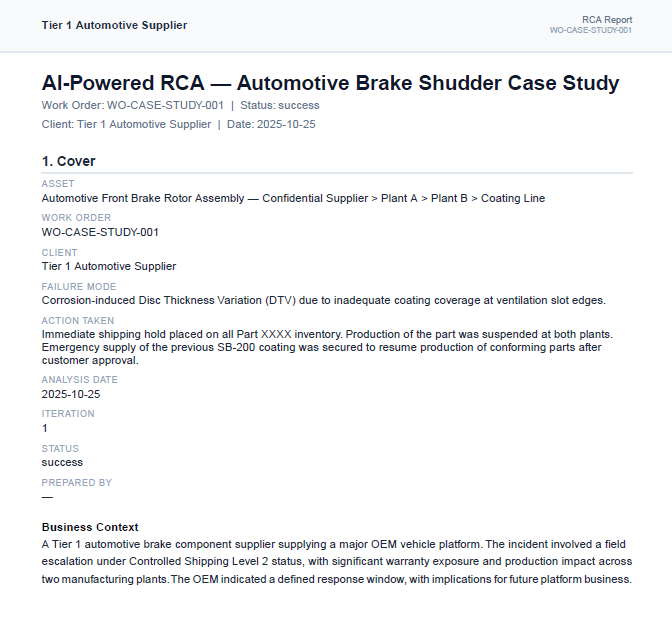
Cover Page & Overview
Work order, asset, failure mode, client, analysis date, and key metrics at a glance.
Grounded root cause narrative with probable causes and corrective action recommendations.
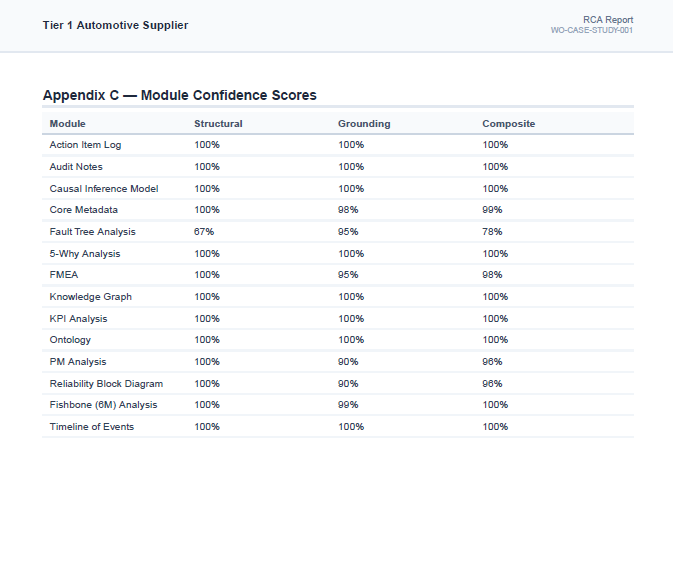
Structural, grounding, and composite confidence scored per analytical module.
The Impact
Traditional RCA vs. AI-Assisted RCA
The analytical depth is the same. The time investment is not.
Traditional RCA
- 2–3 senior engineers pulled from other work
- 2–3 weeks of investigation and documentation
- Findings vary with engineer experience
- No formal evidence citation index
- No confidence or hallucination risk scoring
- Contradictions often silently resolved
- 40-page Word document, inconsistent format
AI-Assisted RCA
- Engineers review and decide — AI synthesizes
- Structured report generated in a single session
- Same analytical depth, every investigation
- 109 citations indexed against evidence items
- Per-module confidence and hallucination risk scored
- Contradictions detected, flagged, and resolved
- Audit-ready structured PDF, consistent format
The engineers still own the investigation. They review, challenge, and override every finding. What changes is the time from incident to investigation-ready report.
Have a Failure Event That Needs Investigation?
See what AI-assisted RCA looks like on a real case from your industry — automotive, oil & gas, industrial, or process manufacturing.